7 Master Bedroom Secrets Interior Designers Use in Small Spaces
How to create luxury in 120 square feet—the professional formula that makes small bedrooms feel twice as big (even renters can try Secret #4)
The conversation around small master bedrooms typically revolves around what you must sacrifice: the king-size bed, the reading chair, the proper dresser. This narrative of limitation misses something fundamental about how professional designers approach compact spaces. They do not begin with constraints—they begin with strategy.
A 120-square-foot master bedroom designed by someone who understands spatial principles feels more expansive and substantially more luxurious than a poorly conceived 200-square-foot room. The difference lies not in square footage but in the application of specific techniques that manipulate perception, maximize function, and prioritize quality over quantity.
What follows are seven secrets that interior designers employ when transforming small master bedrooms—practical strategies that work regardless of whether you own your home or rent, whether your budget stretches to fifteen hundred dollars or one hundred and fifty. These are not aesthetic preferences but proven methods for creating spaces that feel significantly larger than their measurements suggest.
Secret #1
The Low-Profile Platform Bed: Reclaiming Visual Volume
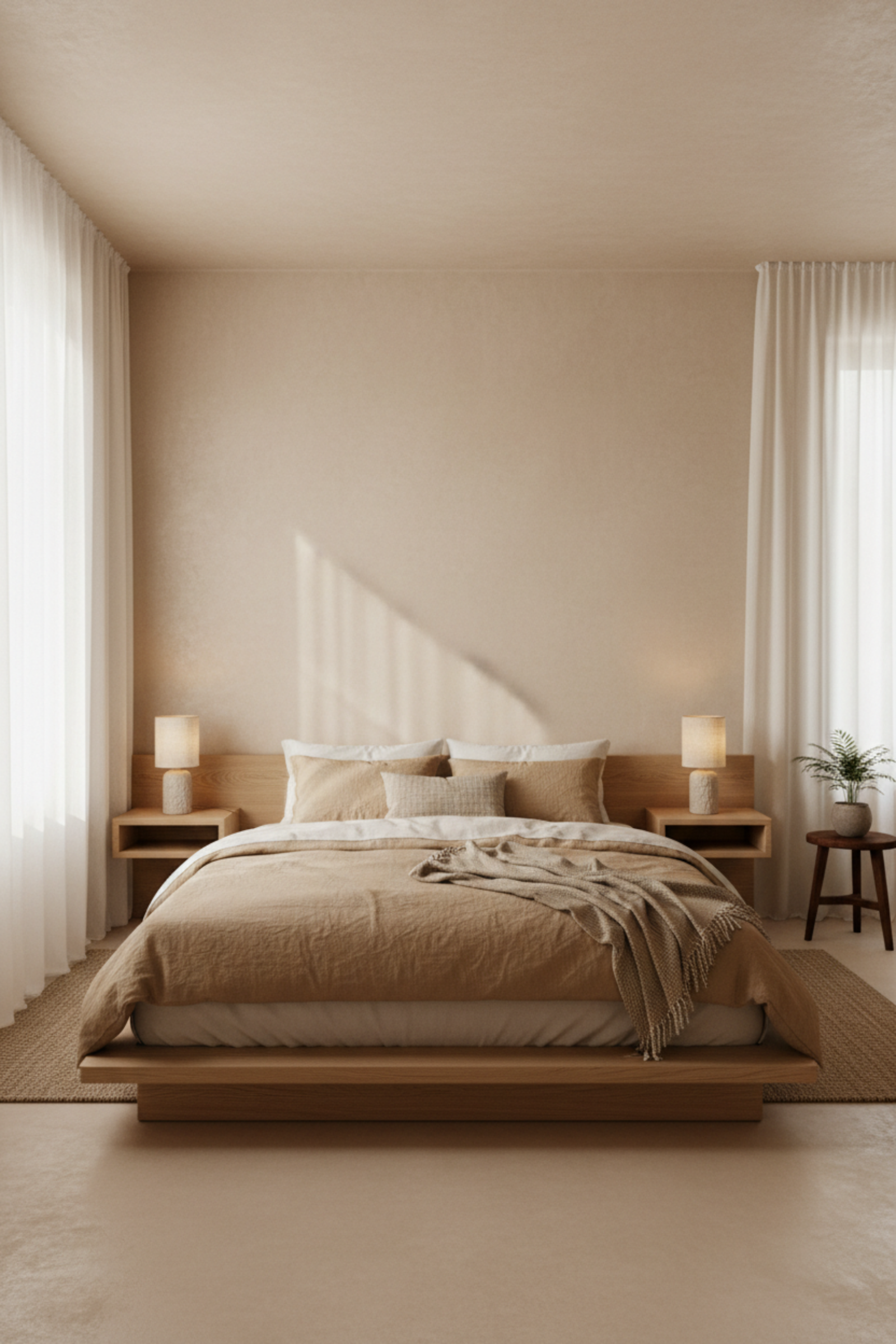
The single most impactful decision in a small master bedroom involves your bed selection—not its size, but its height. Traditional bed frames with substantial headboards and footboards consume visual volume that small spaces cannot afford to surrender. Platform beds that sit low to the ground fundamentally alter a room’s proportions by creating what designers term “vertical breathing room.”
When furniture sits lower, walls appear taller. This is not optical illusion but visual mathematics: the eye measures space in relative proportions. A bed frame twelve inches from the floor leaves forty-eight more inches of visible wall height in an eight-foot room compared to a traditional frame at twenty-four inches. This additional wall space registers subconsciously as roominess.
Contemporary platform beds offer another advantage: integrated storage. Drawers built into the base eliminate the need for separate dressers, freeing floor space while maintaining storage capacity. This represents the designer principle of consolidation—combining functions into single pieces rather than scattering them across multiple furnishings.
The Measurement Reality
Before purchasing any bed frame for a small master bedroom, map your room to scale. Your bed should consume no more than one-third of your floor space. In a 10×12 room (120 square feet), a queen bed with minimal clearance works; a king typically overwhelms. Prioritize comfortable sleep over maximum mattress size—poor circulation around furniture creates claustrophobia regardless of bed dimensions.
Secret #2
Vertical Design Strategy: When Floor Space Is Finite, Build Upward
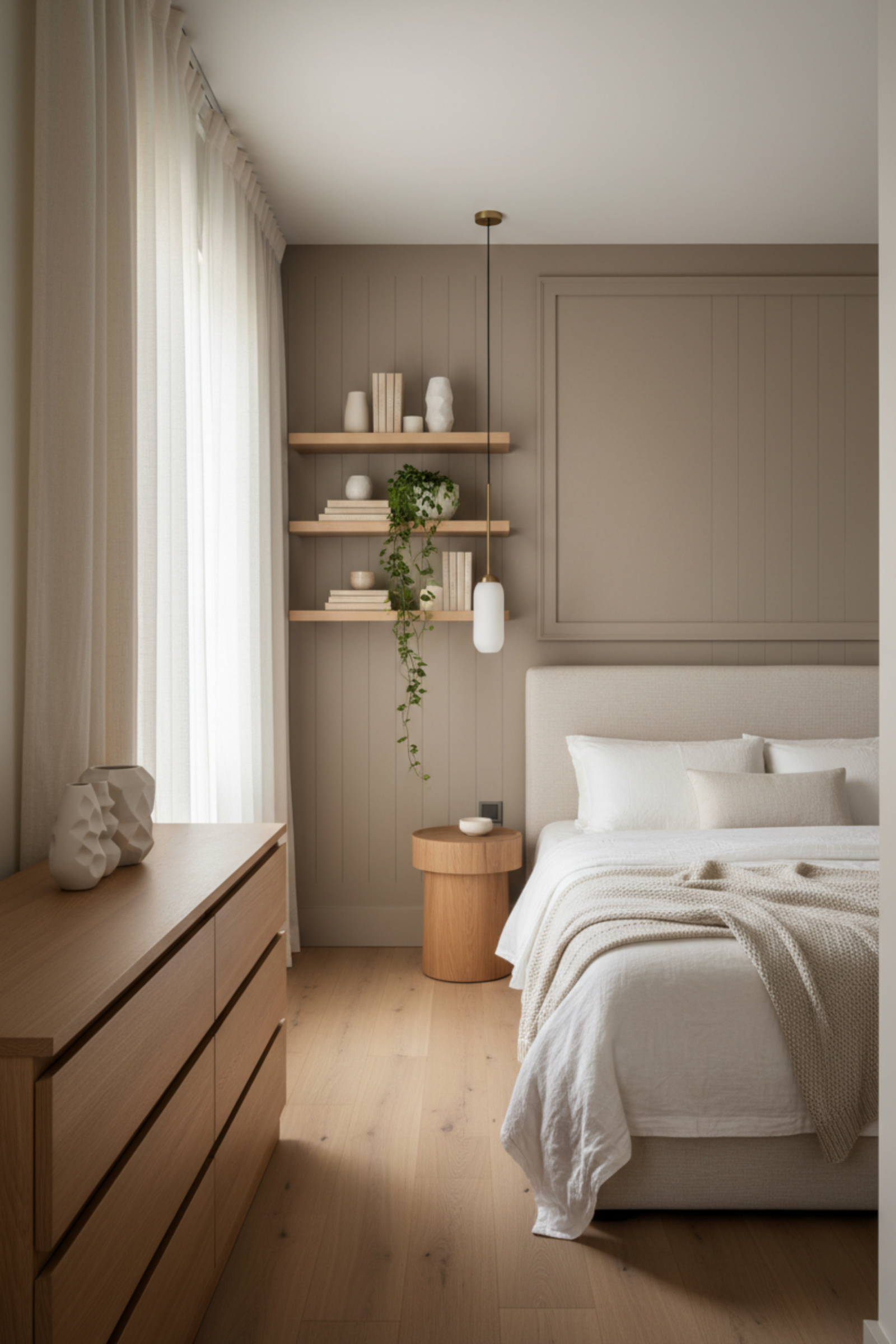
Small bedrooms demand vertical thinking. While floor area remains fixed, ceiling height offers unexploited territory. Designers maximize this dimension through specific techniques that draw the eye upward while adding functional storage and visual interest at elevated levels.
Floor-to-ceiling curtains represent the most accessible vertical intervention. Standard curtain panels that hang from just above the window frame to just below the sill create horizontal lines that emphasize the room’s width—precisely what small spaces do not need. Mounting curtain rods at ceiling height and allowing fabric to puddle slightly on the floor creates unbroken vertical lines that suggest greater room volume.
This technique works regardless of window size. Even a modest window treated with floor-to-ceiling curtains becomes an architectural feature that commands attention upward. The cost differential between standard and ceiling-height curtains is minimal—primarily the rod position and additional fabric length—yet the spatial impact is substantial.
Wall-mounted storage extends this vertical strategy. Floating shelves installed above the bed, flanking windows, or spanning entire walls provide storage and display space without consuming floor area. A single floating shelf can replace a traditional nightstand, keeping floors clear while offering identical functionality.
The Vertical Rule of Thirds
Divide your wall height into thirds visually. The bottom third (0-32 inches) should remain relatively clear—only essential furniture. The middle third (32-64 inches) handles primary functions: headboard, artwork, functional storage. The upper third (64 inches to ceiling) can accommodate decorative shelving, statement lighting, or architectural details. This distribution prevents visual weight from settling at floor level, where it makes rooms feel smaller.
Secret #3
Monochromatic Mastery: The Sophisticated Path to Spaciousness
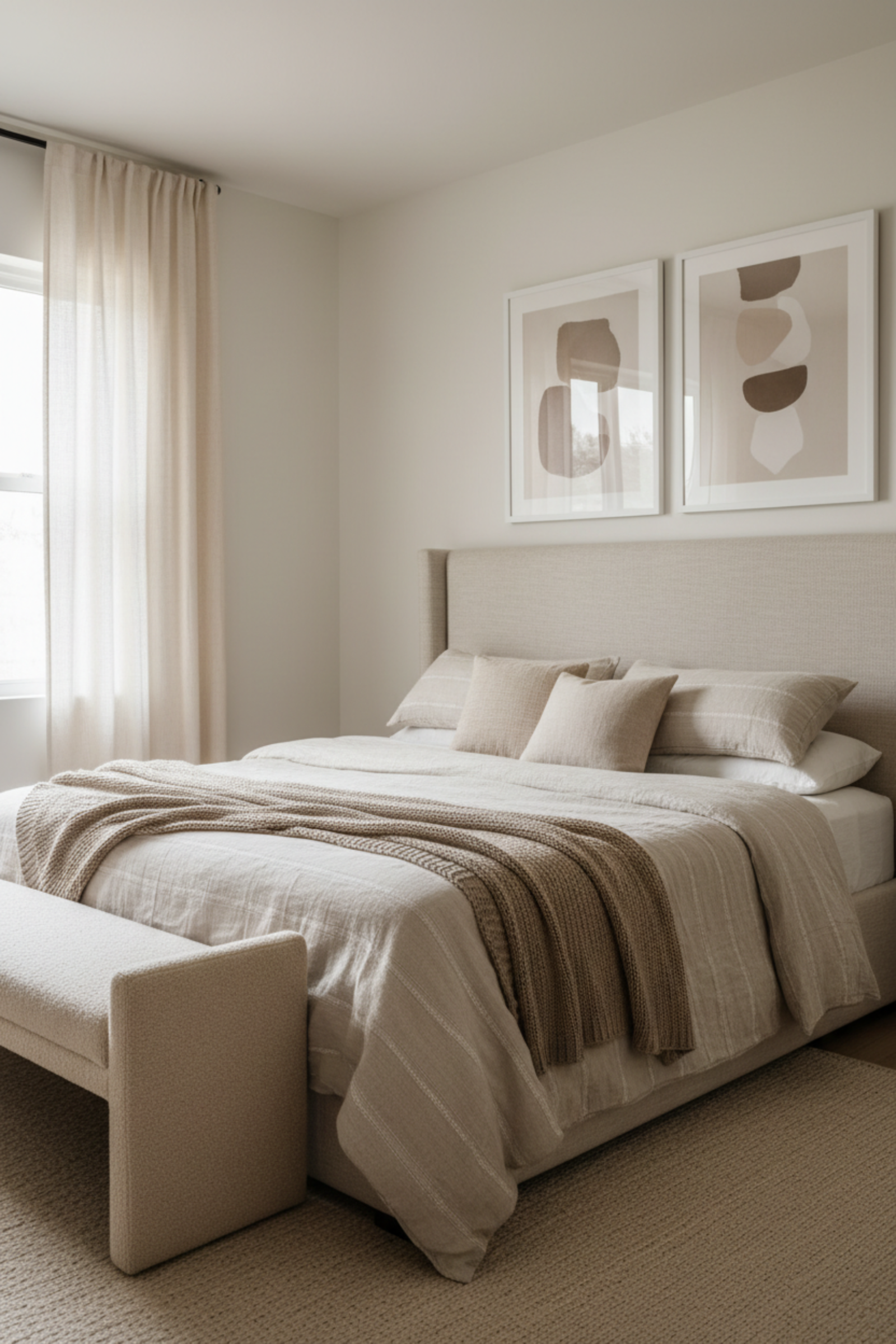
Color possesses measurable psychological impact on spatial perception. Designers understand that monochromatic schemes—variations of a single hue rather than stark white minimalism—create visual continuity that makes boundaries less defined and spaces feel more generous.
The common assumption holds that white walls expand space. This is partially accurate but incomplete. White reflects light, yes, but it also highlights every edge, corner, and transition. A more nuanced approach uses a cohesive neutral palette—warm beiges, soft grays, muted taupes—applied consistently across walls, bedding, and larger furnishings. This creates what designers call “visual flow”: the eye travels through the room without catching on color transitions that fragment space.
Linen bedding in monochrome tones exemplifies this principle beautifully. Natural linen offers textural interest through its inherent weave and subtle wrinkles, preventing monotony while maintaining color harmony. The material’s matte finish avoids the sheen that can make small spaces feel busy or cluttered.
This does not require abandoning all color. The monochromatic base allows strategic accent placement—a single piece of artwork, a throw pillow, a small plant—to register as intentional rather than chaotic. The proportion matters: roughly eighty percent neutral, twenty percent accent.
The Temperature Constant
Maintain consistent color temperature throughout your palette. If your base neutral leans warm (beige, cream, warm gray), all elements should share this warmth. Mixing warm and cool tones—beige walls with cool gray bedding, for instance—creates visual discord that fragments space. This consistency matters more than the specific color chosen.
Secret #4
The Renter’s Revolution: Peel-and-Stick Paneling for Architectural Interest
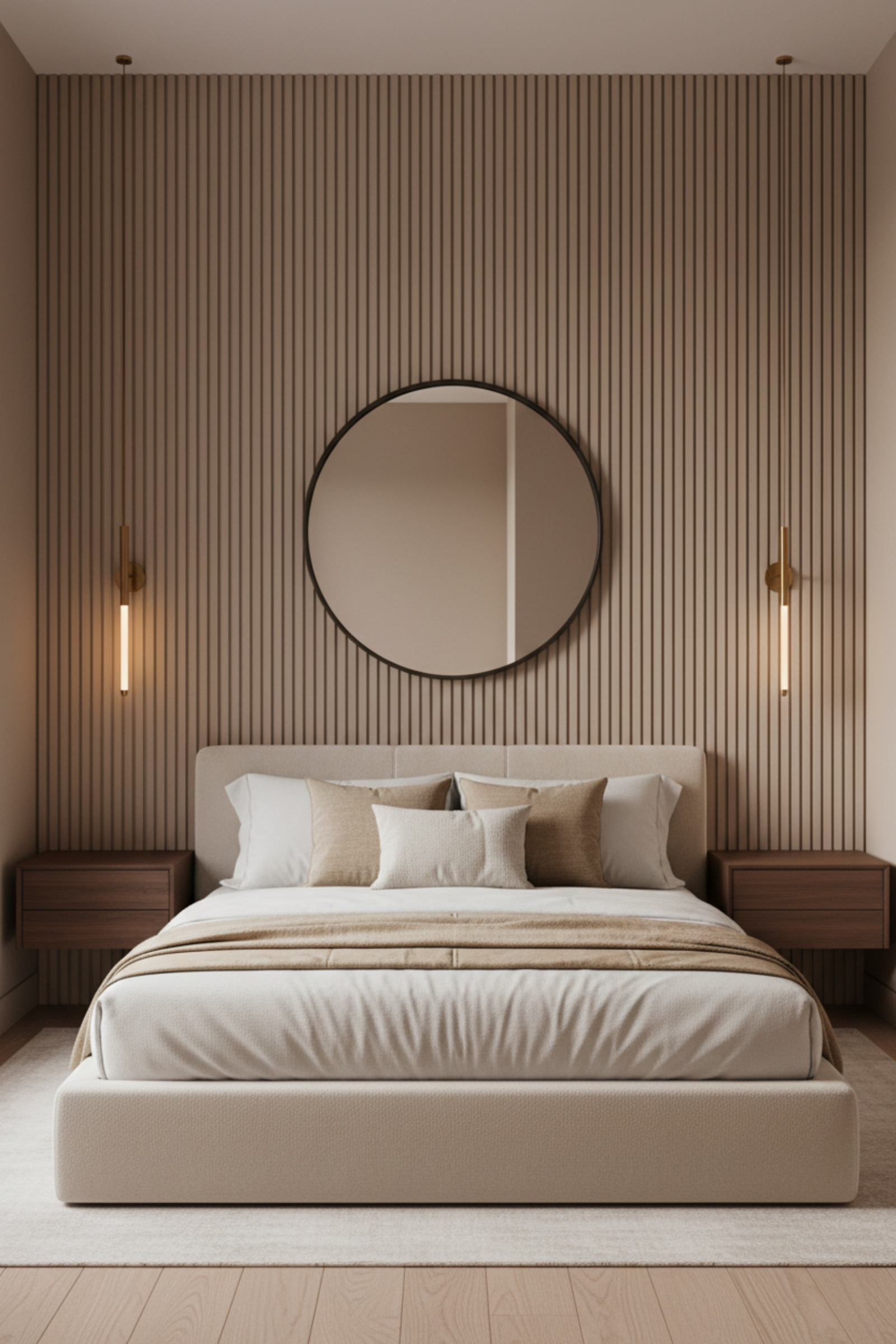
Here resides the secret even renters can implement: removable wall treatments that add architectural depth without permanent alteration. Peel-and-stick wall paneling has evolved substantially beyond its origins as a temporary solution. Contemporary options offer convincing textures—shiplap, board-and-batten, subtle geometric patterns—that introduce dimension to flat walls.
Why does this matter for spatial perception? Flat, featureless walls in small rooms feel confining because they offer no visual interest to suggest depth or complexity. Strategic paneling—particularly when applied to a single accent wall behind the bed—creates layered planes that trick the eye into perceiving greater distance.
The application technique matters. Full-wall coverage from floor to ceiling maintains the vertical emphasis discussed in Secret #2. Stopping paneling midway up the wall creates a horizontal division that diminishes perceived height. The investment ranges from one hundred fifty to four hundred dollars depending on room size and panel selection—remarkably reasonable for the visual impact achieved.
For renters specifically, peel-and-stick solutions offer psychological benefits beyond aesthetics. The ability to personalize space despite lease restrictions transforms one’s relationship with the room. This is not superficial: feeling ownership over your environment, even temporary ownership, affects how you inhabit and maintain that space.
Installation Essentials
Successful peel-and-stick application requires proper surface preparation. Walls must be clean, dry, and relatively smooth. Textured walls require a different adhesive strategy or primer application. Test a small section in an inconspicuous area first. During removal, peel slowly at a 45-degree angle to minimize paint damage. Keep a hair dryer nearby—gentle heat softens adhesive for easier removal.
The most successful small bedrooms are not those that apologize for their size, but those that leverage it—creating intimacy and intentionality impossible in larger, less focused spaces.
Secret #5
Reflective Surfaces: Strategic Mirror Placement for Dimensional Expansion
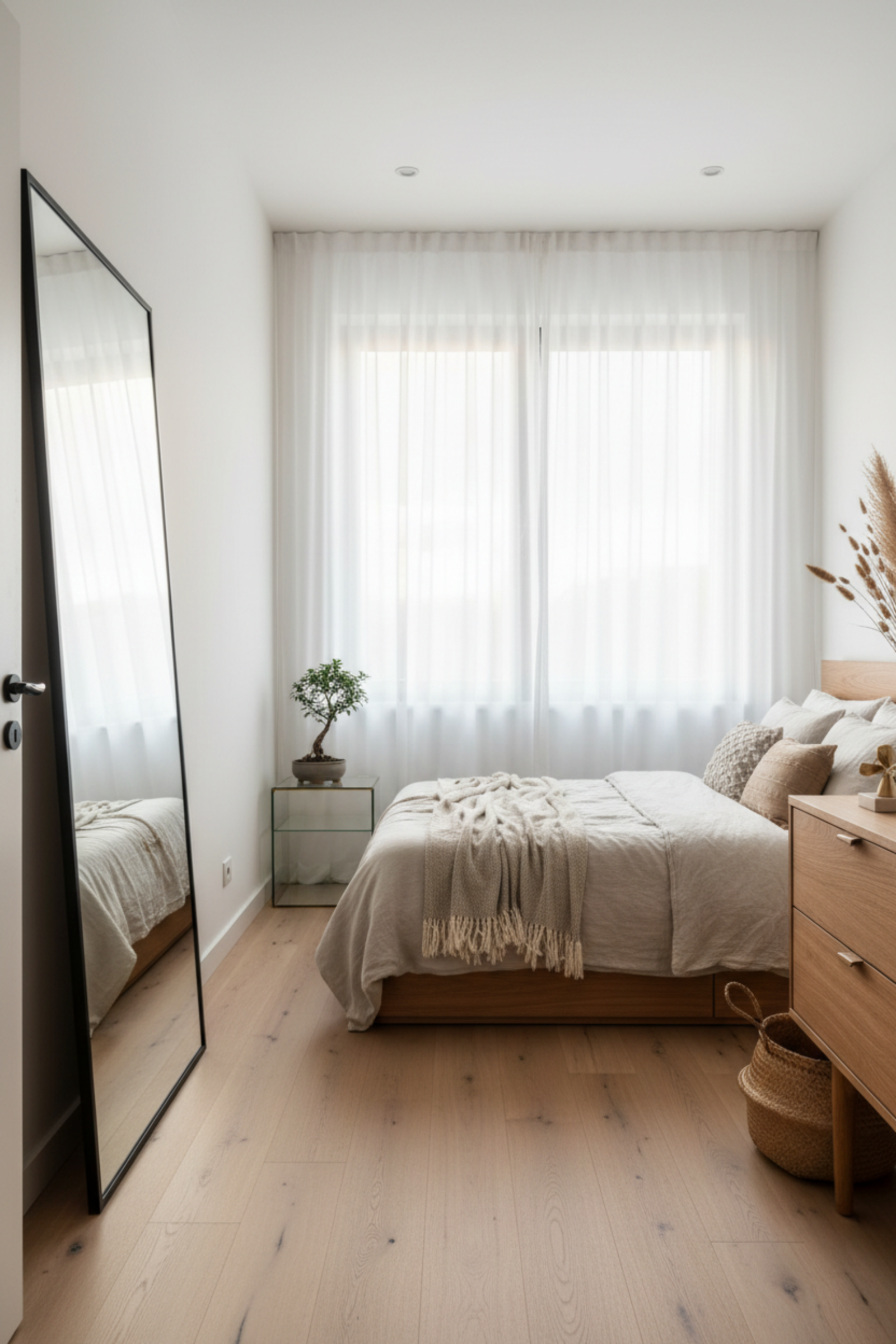
Mirrors represent perhaps the oldest spatial manipulation technique, yet their application requires more sophistication than simply mounting the largest available mirror on any open wall. Effective mirror placement considers sightlines, light sources, and what the reflection reveals.
The optimal mirror position in a small master bedroom typically sits opposite or perpendicular to a window. This captures and multiplies natural light—the most valuable commodity in compact spaces. A mirror reflecting a blank wall or cluttered corner provides dimension without delight; a mirror reflecting light, greenery from outside, or an attractive architectural feature doubles those positive elements.
Size matters, but not in the obvious direction. One substantial mirror (minimum thirty inches in any dimension) makes more impact than multiple small mirrors. The large mirror reads as architectural element rather than decoration, suggesting the wall extends beyond its actual boundaries. Frameless mirrors or those with minimal framing maintain clean lines that prevent visual fragmentation.
Consider unconventional placements. A mirror leaning against the wall on a dresser or floor—rather than hung—creates casual sophistication while avoiding wall damage (crucial for renters). The slight angle can actually enhance light reflection compared to perpendicular mounting.
The Reflection Test
Before committing to mirror placement, use a handheld mirror to preview what the mounted mirror will reflect. Stand where you will most frequently see the mirror—from the bed, from the door—and hold your test mirror in the proposed position. If the reflection shows attractive elements (light, window, appealing decor), proceed. If it reveals clutter or uninteresting views, reconsider the location.
Secret #6
Multipurpose Furniture: Consolidation Without Compromise
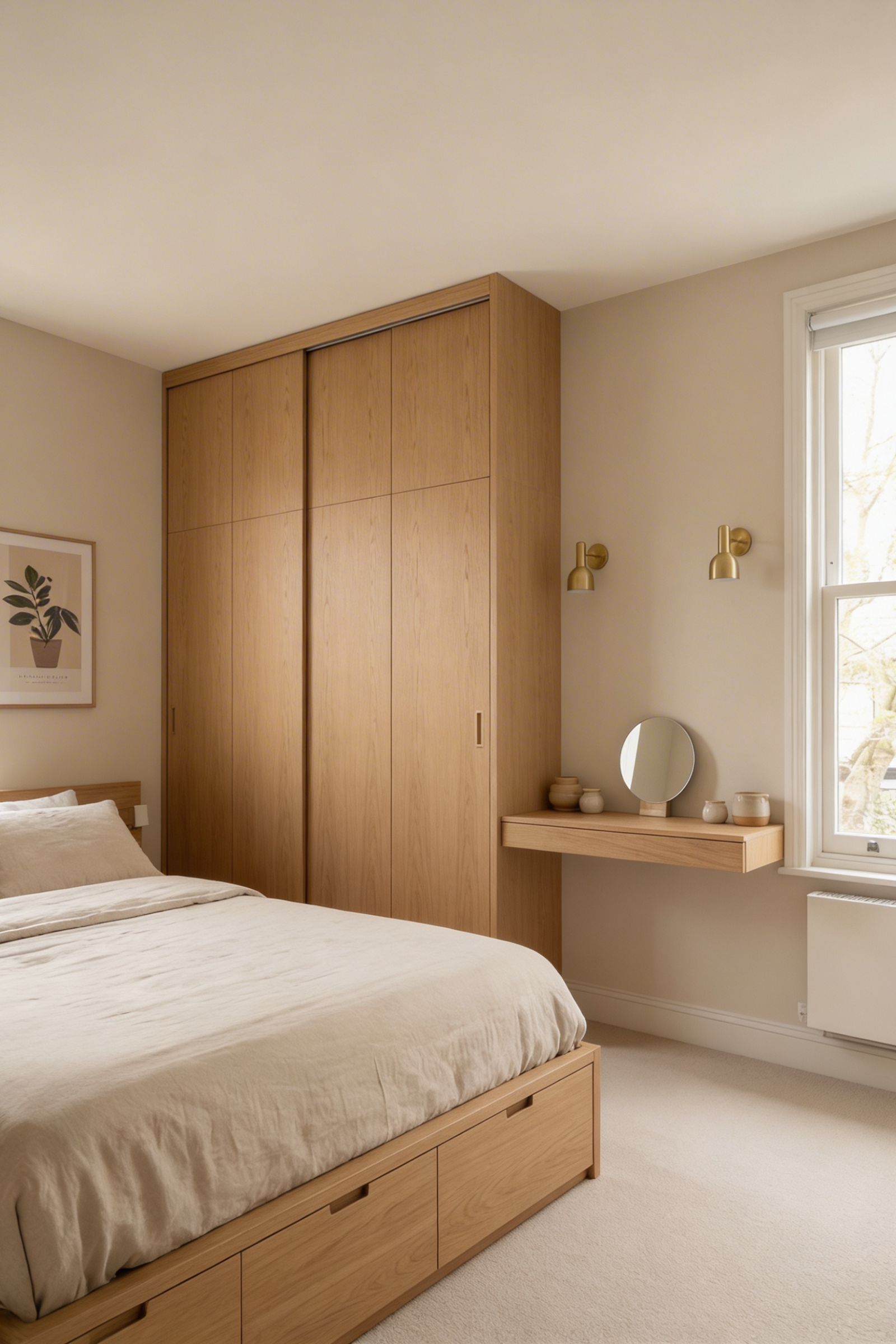
Small master bedrooms cannot accommodate furniture that serves singular purposes. The traditional nightstand that merely holds a lamp and water glass represents wasted opportunity. Designers instead select pieces that layer multiple functions into compact forms.
A nightstand with substantial drawer storage replaces the need for additional dresser space. A storage ottoman at the foot of the bed provides seating, surface area, and concealed storage for extra linens. A wall-mounted fold-down desk creates workspace that disappears when not needed. These are not compromises but optimizations.
The evaluation criterion becomes straightforward: does this piece serve at least two distinct purposes? If not, can it be replaced with something that does? This thinking extends to every element. A headboard with integrated shelving eliminates nightstand requirements. A bed frame with drawers replaces under-bed storage bins.
Quality remains paramount in multipurpose furniture. A flimsy storage ottoman that breaks after six months serves zero purposes. Better to invest two hundred dollars in a well-constructed piece than one hundred on something requiring replacement annually. This calculates as both economic and spatial efficiency.
The Function Matrix
Before purchasing any furniture piece for a small master bedroom, list its intended functions. Aim for three: a nightstand might provide storage (drawer), surface area (top), and display space (open shelf). If you can only identify one function, continue searching for a more versatile solution or reconsider whether you need that piece at all.
Secret #7
Lighting Layers: Creating Depth Through Illumination Strategy
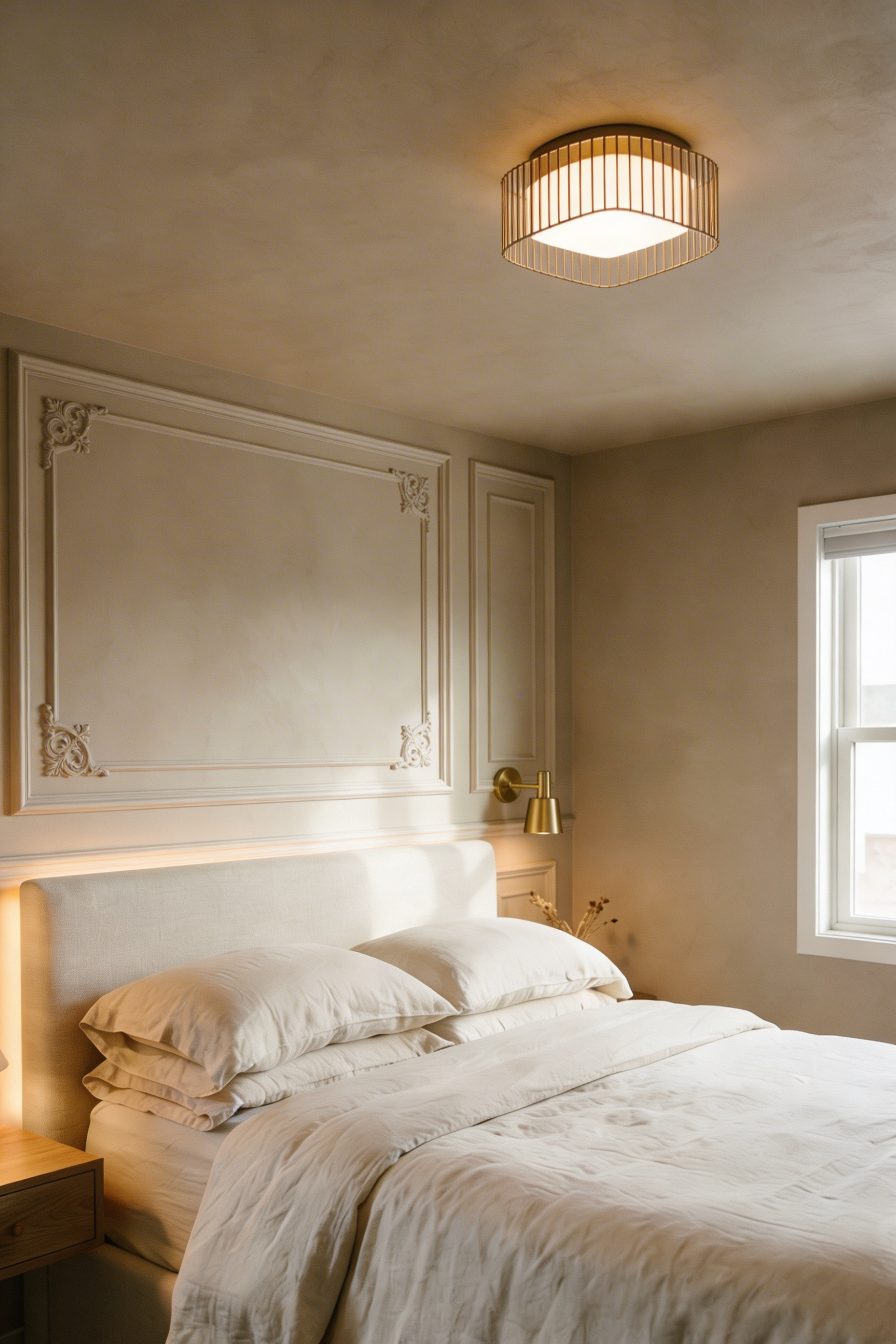
Poor lighting makes any bedroom feel smaller. Single overhead fixtures create harsh shadows and flat illumination that emphasizes a room’s limitations. Designers instead employ layered lighting—multiple sources at varying heights—that adds depth and allows atmospheric adjustment throughout the day.
The three-layer approach combines ambient (overall room lighting), task (functional light for specific activities), and accent (highlighting architectural features or artwork). In small bedrooms, this might translate to: a dimmer-controlled ceiling fixture or pendant (ambient), wall-mounted reading sconces flanking the bed (task), and LED strips behind floating shelves or under the bed frame (accent).
This layering serves practical and perceptual purposes. Functionally, you can adjust lighting for different activities—bright for dressing, subdued for reading, minimal for sleep preparation. Perceptually, multiple light sources at different levels create visual complexity that makes rooms feel more dimensionally interesting.
Warm-toned bulbs (2700-3000K) are non-negotiable in small bedrooms. Cool white lighting makes spaces feel institutional and highlights every limitation. Warm light creates the impression of natural sunlight filtering through the room, inherently more inviting and expansive-feeling.
The Lighting Budget
Allocate your lighting budget toward dimmer switches and quality bulbs rather than expensive fixtures. A fifty-dollar pendant with a twenty-dollar dimmer switch and quality LED bulbs outperforms a two-hundred-dollar fixture with standard bulbs and no dimming capability. The ability to adjust light intensity transforms how a room functions across different times and purposes.
Bringing It Together: The 120-Square-Foot Blueprint
Consider a specific example: a 10-foot by 12-foot master bedroom (120 square feet total). Applying these seven secrets transforms this modest space into something substantially more livable and visually generous.
The room begins with a low-profile queen platform bed with integrated storage drawers, eliminating the need for a separate dresser. The bed sits against the longest wall, leaving maximum floor clearance. Floor-to-ceiling linen curtains in warm oatmeal hang from ceiling-mounted rods, creating unbroken vertical lines at the room’s single window.
All bedding—duvet, sheets, throw—maintains a monochromatic palette in natural linen and cotton, varying only in texture rather than color. The wall behind the bed features peel-and-stick shiplap paneling in soft white, adding architectural interest without permanent alteration. This benefits renters particularly, as the entire installation requires only an afternoon and removes cleanly upon move-out.
Rather than traditional nightstands, floating shelves with single drawers mount at mattress height on either side of the bed. These provide identical functionality while keeping floors clear—crucial for maintaining visual openness. A large leaning mirror positioned perpendicular to the window reflects natural light throughout the day, effectively doubling the room’s brightness.
At the bed’s foot sits an upholstered storage ottoman that conceals extra linens and provides both seating and surface area when needed. Wall-mounted reading sconces eliminate the need for table lamps, freeing the floating shelves for books and a small plant. LED strips installed beneath the bed frame create subtle ambient lighting for nighttime navigation.
The total investment for this transformation ranges between eight hundred fifty and fifteen hundred dollars depending on specific product selections. More importantly, the space functions efficiently while feeling substantially larger than its measurements. This is not magic but methodical application of proven design principles.
The Maintenance Mindset
Small master bedrooms demand ongoing discipline that larger spaces can forgive. Clutter that barely registers in a spacious room becomes overwhelming in compact quarters. The trade-off for creating a beautiful small bedroom is maintaining that beauty through consistent organization.
This does not require perfection but intentionality. Daily bed-making takes on greater importance—the bed occupies such visual dominance that its state affects the entire room’s appearance. Weekly surface clearing prevents accumulation. Monthly reassessment identifies items that no longer serve purpose and can be removed.
View this maintenance not as burden but as practice. Small spaces teach valuable lessons about consumption, necessity, and sufficiency that apply far beyond bedroom walls. Living well in limited space requires thinking carefully about what you bring into your environment—a skill that serves you regardless of future living situations.
Final Considerations
These seven secrets share a common foundation: they prioritize perception over actual dimensions. A small master bedroom will never become physically larger, but it can absolutely feel more spacious, function more efficiently, and provide greater comfort through strategic design decisions.
The most successful small bedrooms are those where every element has been considered, where nothing is accidental, where form and function align precisely because space limitations demand such alignment. This level of intentionality produces rooms of remarkable character—spaces that feel curated rather than cramped, purposeful rather than limited.
Whether you’re working with 120 square feet or 180, whether you own or rent, whether your budget is substantial or modest, these principles adapt to your specific circumstances. The core truth remains constant: small bedrooms designed with intelligence and care outperform larger bedrooms designed carelessly. Size matters far less than strategy.